
Current e-Journal
-


November 11, 2025
Are you really walking your talk?
In this week’s Systems Change Newsletter…
- Invitations and Announcements
- Catalytic Thinking Exercise: Are you really walking your talk?
- Resources to Further Your Practice
Invitations and Announcements:
Help the Helpers (and Yourself)
If you are in the U.S., there is so much you can do to fight the authoritarian destruction we are witnessing. Donate to the National Council of Nonprofits. Subscribe to the Chronicle of Philanthropy (it’s only $8 per month!). And then there’s the folks who are fighting the good fight in the courts, like the American Civil Liberties Union and the NAACP Legal Defense Fund. It’s not just the support that helps; these resources will keep you informed.
Catalytic Thinking Exercise:
Are you really walking your talk?
In our most recent podcast interview, the co-CEO of Justice Funders, Dana Kawaoka-Chen, talks about the importance of walking the talk of your values. What does it look like when the actions you take are modeling what you want to see in the world?
We all know what it looks like when folks are not walking that talk. Those become the horror stories we see in the news and often talk about for years.
In the early 2000s, Enron was such a huge corporate scandal that their CEO went to jail. And yet the values posted in their lobby included words like “respect, integrity, and honesty.”
“Being the change we want to see” means walking the talk of our values.
~ The Pollyanna Principles
In the nonprofit world, the main fundraiser for a recovery organization was an event where the most prominent part of their ads featured “Beer, Wine, and Cocktails.”
Then there is the domestic violence organization whose board was so abusive to the staff, that the staff organized a union to protect themselves.
We also know what it looks like when decisions are made to consciously align with values. In Hildy's book, The Pollyanna Principles, she shares the story of the accountant who became CEO of an organization serving people in need. During his first year on the job, the CEO alerted the board to a program that was not paying for itself. The board was intent on keeping the program, as it was doing tremendous good for many people. They told their new CEO, “These have been our values for almost 200 years. That is what we are about. And that will define what we will do.”
What, then, does it take to walk the talk of the values your organization holds dear?
Try this
First, let’s define the word values. Values are simply the things that are important to you as you make decisions. Values are therefore at the heart of all the choices you make.
When the recovery group chose a drinking event as their fundraiser, that decision was clearly rooted in a value that was not posted in their lobby - valuing the need for funds. However, if they had had a conversation about how that event would (or would not) align with the values they posted in their lobby and on their website, they might have made a very different decision.
What that tells us is simple:
Aligning your walk and your talk is not just about coming up with a statement of values. That alignment is about determining what those values look like in action in everything you do.
Every week at their staff meeting, a hospital CEO asks, “What evidence have you seen this week of our values in action?” In one memorable response, someone talked about a janitor who cared so much for a patient's welfare, that they summoned the nurse when they sensed that something was wrong.
What will your values look like in action with your own janitor? With the way you treat the janitor, and the way the janitor feels about their work?
What will your values look like at the reception desk? Or do you even have a reception desk? Is your phone answered by a human or by a system that requires that you punch in several different numbers and eventually just get to voicemail? And how does that align with your values?
Consider a different recovery organization. This group had articulated their values, and at every board meeting and strategy meeting, a copy of those values was printed and placed in the center of the table.
During one particularly sticky conversation, board members were going back and forth about what to do, when one board member reached over and grabbed a copy of that values statement. He looked at his colleagues and said, “We can stop debating this. The answer is right here.”
Your organization’s values are nothing if you don’t put them into action. Taking time to articulate those values is therefore only Step 1. Steps 2 through infinity are to ask what those words will look like with real people making real decisions.
The work, then, is…
- Consider every position in your organization and every function those positions serve.
- Then consider what your values will look like in action for that position and that work.
These are energizing conversations for every manager to have with their teams. And at staff meetings, those conversations open the door to the question asked by that hospital CEO: What evidence have you seen this week of our values in action?
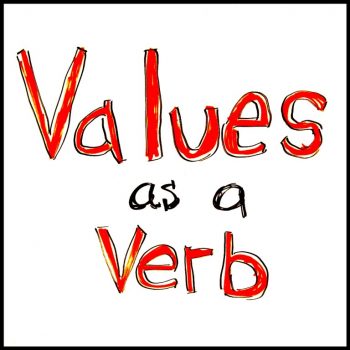
One of the core values at the heart of Catalytic Thinking is Radical Strength. When values are a verb - something that we will put into action – those values become the most radical strength you will have to build upon.
Resources to Further Your Practice
- READ: At Creating the Future, our values statement encompasses a long list of what our values look like in action. Read that here…
- LISTEN: In this energizing podcast, Justice Funders co-CEO Dana Kawaoka-Chen shares all kinds of examples of what it looks like to put values into action. Listen here…
- READ: How to determine your values: This free workbook provides questions that will lead you to your own code of values. It’s also a great way to confirm if you are walking the talk of those values! Download it here…
Help Keep Our Programs Freely Available
Creating the Future’s eJournal is free. And there are no financial barriers to our classes – tuition is whatever folks can afford. Because we never want money to stand in the way of people learning.
If you value our content and our approach, please donate here – and please consider becoming a monthly supporter of our work.
eJournal Archives:
If you’re new to our eJournal, or just want to remind yourself of past practice exercises we’ve shared, check out our eJournal archives here.

SUBSCRIBE
to get this e-Journal
Creating the Future is a 501(c)(3) tax exempt organization in the U.S.A