
Current e-Journal
-


February 24, 2026

"If we were powerless, they'd be ignoring us."
~ Janai Nelson,
NAACP Legal Defense Fund
In this week’s Systems Change Newsletter…
- Invitations and Announcements
- Catalytic Thinking Exercise:Yes, you’re just one person. One POWERFUL person.
- Resources to Further Your Practice
Invitations & Announcements:
Only 3 Seats Left
Just for planning consultants: YOU could be the key to helping groups step into their power during these dark times. The plans you facilitate can provide organizations with strength and confidence, even during these uncertain times. In our upcoming webinar, you will learn a planning approach rooted in strength and possibility. Hildy explains more in the video here…
Catalytic Thinking Exercise:
Yes, you’re just one person. One POWERFUL person.
When the world is bombarding us with all that is wrong, it’s easy to start feeling like no matter what we do, it’s not enough.
Unfortunately, that emotional fatigue can actually lead to doing LESS, not more. We say things like “I’m just one person. What I do won’t make a difference.” Or perhaps, “I’m not brave like the folks on the front lines. I don’t want to be arrested. They’re the ones making a difference.”
And of course, that’s when the powers that be win.
But…
When we change the way we see things, things change. Instead of seeing ourselves as just one meaningless drop of water in the vast ocean, we can see that WITHOUT ALL THOSE INDIVIDUAL DROPS, THERE IS NO OCEAN!
As civil rights leader Janai Nelson reminds us, "If we were powerless, they'd be ignoring us." That is echoed by pastor John Pavlovitz, noting, “They can’t stop us if we all resist.”
And in the words of Roshi Joan Halifax,
Instead of seeing ourselves as just one meaningless drop of water in the vast ocean, we can see that WITHOUT ALL THOSE INDIVIDUAL DROPS, THERE IS NO OCEAN!
"We have to look deeply and find the cracks in the systems, and find our way into the cracks, to thoroughly break open the way forward. Each one of us is a leverage point in our world. Be like water. Find your way into the cracks."
What does it take, then, to find where each of us can be that drop of water, seeping our way into the cracks to make that difference?
And if you work within an organization, what would it take for your group to activate all the drops of water in your community?
Try this
Catalytic Listening encourages us to listen for people’s aspirations, their strengths, and their values. At this moment, imagine the power in listening for those attributes not just in others, but in ourselves as well!
And imagine the power of applying those attributes to the people we care most about – the people in our neighborhoods and our communities. As Roshi Joan suggests, that is where we can most easily find the cracks we can seep into.
Listening for your aspirations and values will help you determine where to aim your efforts.
- What do you care most about in your community? Your neighborhood? Your state or province?
- What is most important to you?
- What wrong do you wish you could help to make right?
This is about finding that one place you can aim your efforts – all your drops of water – to make a difference. It could be homelessness or domestic violence (both of which are increasing during these difficult times). It could be environmental concerns, or animal rights. It could be a general sense of community belonging.
By asking, “What is most important to me? What do I care about the most? What makes me the most angry / upset?” you will be guided by your values and aspirations to identify where to focus. No one can focus on everything. But each of us can focus on one thing that we care about passionately.
As organizational leaders, you can be engaging your community members in this conversation (instead of using precious billboard and social media time asking for donations over and over). Imagine a billboard that says, “Wondering how you can make a difference in these times? If you care about fill-in-the-blank, we’ve got some ideas. Come talk to us!”
Listening for your strengths will help you find what actions make sense for you.
- What do you do well?
- What do others say you do well? What do they appreciate about you?
- What brings you joy? What do you love to do, and wish someone would ask you to do?
- What do you have time for? Is it 5 minutes per day, or 1 day per week?
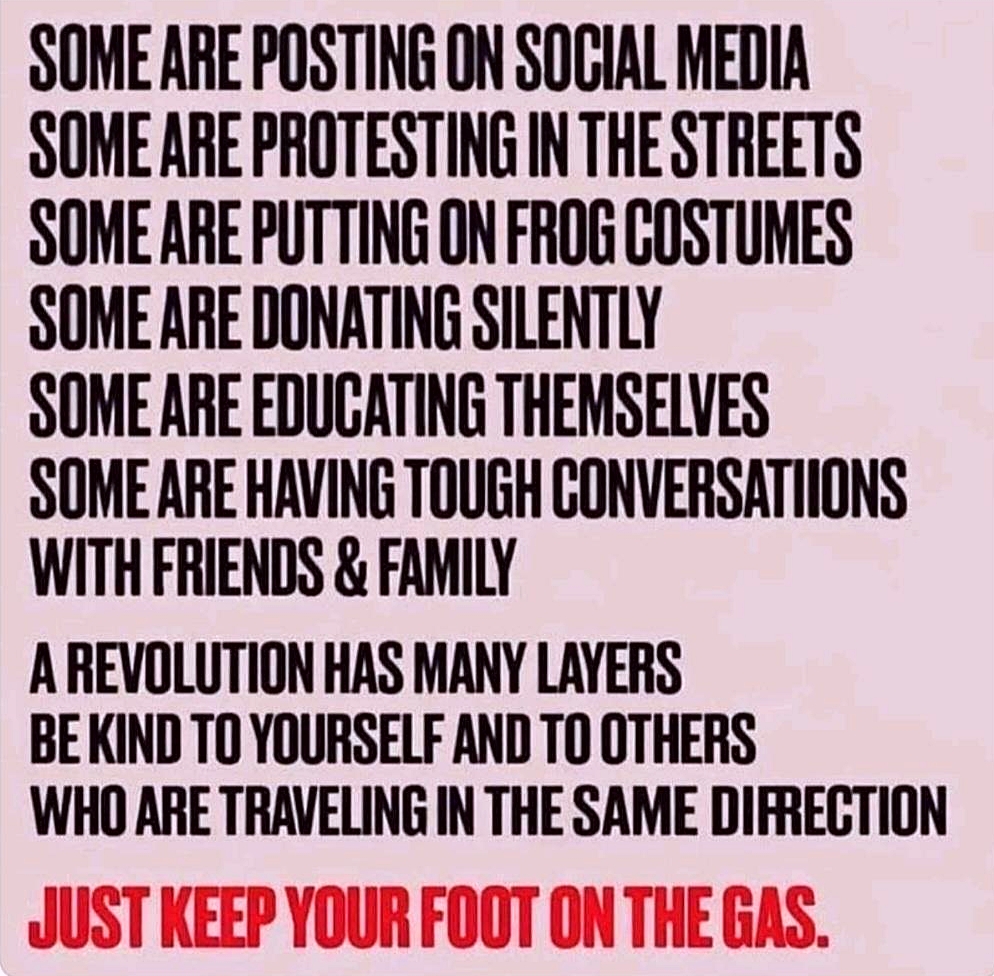
Whatever you are good at and love doing – and whatever you have the time to take on - there is something you can do. If your time is limited or you are uncertain about where you fit, you can write letters. You can call elected leaders (local leaders are more likely to actually take your calls!). You can donate money. All of that matters.
Those of you who work in nonprofits and other change organizations, you know the power of having a monthly donor. You know the power of getting folks to write letters or make calls. In your newsletters and other communications, let people know that those seemingly insignificant acts make a huge difference!
If you have a bit more time – perhaps 1 whole day per week or per month – there is almost certainly a group in your community that would love for you to help them. If you’re good with people, if you’re good with animals, if you love to garden, if you are a budding photographer, if your coworkers always ask you to help with X or Y… there is a group doing the work you identified as important, who could use your skills.
We love the question, “What do you wish someone would ask you to do?” One member of our Creating the Future community lives in a small apartment and works in an office all week. What she loves to do, though, is to dig in the dirt, to garden. So on weekends, she heads to the outskirts of town, and helps plant trees to revegetate a fire-stricken patch of forest. She tells us she loves knowing she is helping. And then she whispers, “But really, I just love getting out there and getting dirty with other people who love it, too.”
As organizational leaders, imagine the power of asking your community members what they love to do. Talk about turning volunteer management into engaging community activism!
When the legendary John Lewis talked about getting into good trouble, this is the path to finding and getting into that good trouble. Identify what is important to you – your values and aspirations – and apply your strengths to that.
When it comes to more national or global issues, you can ask the same questions. What do you care most about? And what strengths do you have, to add one more drop of water to that effort? It might be attending a rally, or it might be making a phone call or making a donation or boycotting a company that is creating harm.
The thing to remember is that it takes ALL those drops of water. And that, as John Pavlovitz notes, “They can’t stop us if we all resist.”
That is the spirit of Collective Enoughness, that together we have the power to create the world we want to live in. That spirit of radical strength is at the heart of the Catalytic Thinking framework.
- WATCH: A short clip about what each of us can do, this one inspires us every time we watch it. It may be the best 3 minutes on the Internet! Watch it here…
- READ: This single slide helps you assess your comfort level for various protest activities. We think it’s brilliant. See it here…
- LISTEN: In this episode of the Creating the Future podcast, Zen priest and social activist Joshin Byrnes shares simple ways to connect as humans in community. Listen here…
Help Keep Our Programs Freely Available
Creating the Future’s eJournal is free. And there are no financial barriers to our classes – tuition is whatever folks can afford. Because we never want money to stand in the way of people learning.
If you value our content and our approach, please donate here – and please consider becoming a monthly supporter of our work.
eJournal Archives:
If you’re new to our eJournal, or just want to remind yourself of past practice exercises we’ve shared, check out our eJournal archives here.

SUBSCRIBE
to get this e-Journal
Creating the Future is a 501(c)(3) tax exempt organization in the U.S.A